

When news about Panchayat elections surfaces, it rarely creates noise beyond political circles. But this time feels different. The confirmation of the UP Panchayat Election 2026 dates isn’t just an administrative update — it’s a signal that grassroots democracy in Uttar Pradesh is about to step into motion again, touching villages, blocks, and everyday conversations across the state.
The image circulating online quietly lays out something far more impactful than it appears at first glance: a structured, phase-wise voting plan that will determine who holds power at the village level for the next term. For anyone who understands how deeply Panchayat leadership affects rural life, this timeline carries real weight.
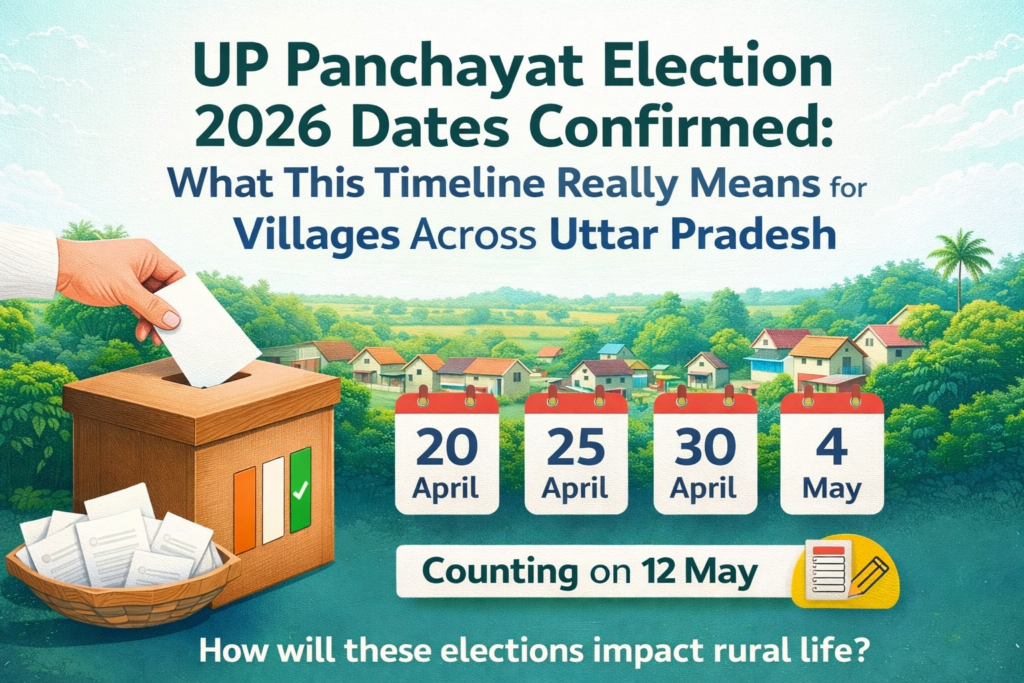
official UP Panchayat election schedule
Why the Date Confirmation Matters More Than People Think
Election dates don’t just decide when people vote. They shape preparation, political equations, alliances, and even local development promises. With the UP Panchayat Election 2026 now officially scheduled in phases from late April to early May, the entire rural political ecosystem has entered countdown mode.
Candidates are no longer speculating. Voters are no longer guessing. Once the dates are locked, hesitation disappears — and action begins. From Gram Pradhan aspirants to ward members, everyone suddenly has a deadline breathing down their neck.
Understanding the Phase-Wise Voting Plan
Unlike single-day elections, Panchayat polls in Uttar Pradesh unfold gradually. This phased structure exists for a reason: scale. Managing voting across thousands of villages, ensuring security, logistics, and fairness, simply can’t happen overnight.
According to the shared schedule, voting will take place in four separate phases, beginning around 20 April and concluding by 4 May 2026. Each phase covers a specific cluster of districts, allowing election authorities to focus resources without chaos.
This approach may feel slow to outsiders, but on the ground, it’s the only way a state as vast as Uttar Pradesh can conduct elections smoothly.
How Villages Experience These Election Phases
For villages included in early phases, the pressure arrives sooner. Campaigning intensifies quickly, walls get painted, loudspeakers wake people up early, and political discussions suddenly dominate tea stalls.
In districts voting later, there’s a different kind of tension — watching outcomes from earlier phases, adjusting strategies, and recalibrating promises. This staggered format subtly changes how politics unfolds from one district to another.
Every phase becomes a lesson for the next.
The Role of Gram Pradhan Elections in Daily Life
It’s easy to underestimate Gram Pradhan elections if you only look at state or national politics. But in rural Uttar Pradesh, the Gram Pradhan isn’t a distant figure — they’re part of daily life.
From road repairs to ration distribution, from housing schemes to sanitation work, decisions made at this level directly shape living conditions. That’s why Panchayat elections often generate more emotional involvement than larger polls.
When villagers line up to vote, they’re not voting for ideology alone — they’re voting for water access, drainage fixes, and accountability.
Why 12 May 2026 Is a Crucial Date
While voting spreads across multiple days, one date ties everything together: 12 May 2026, the day of counting.
This is when weeks of campaigning, debates, and promises collapse into numbers. Counting day is emotionally charged — not just for candidates, but for entire villages. Supporters gather early, rumors spread faster than official results, and celebrations or disappointments unfold in real time.
By evening, power structures at the grassroots level begin to change.
Election Management at a Massive Scale
Conducting Panchayat elections in Uttar Pradesh isn’t just about ballots and boxes. It’s about coordination across thousands of polling stations, millions of voters, and layers of administration.
The responsibility lies with the State Election Commission Uttar Pradesh, which oversees everything from voter lists to security deployment. Their phased scheduling reflects logistical reality, not political convenience.
Each phase reduces risk, improves oversight, and minimizes administrative overload.
What This Election Means for First-Time Voters
For many young voters in rural areas, Panchayat Election 2026 will be their first experience with the ballot. Unlike national elections that feel distant, these polls are personal.
They know the candidates. They’ve seen them at weddings, disputes, and village meetings. Voting isn’t abstract — it’s a direct choice between familiar faces.
This familiarity makes first-time voting both empowering and intimidating, shaping political awareness early in life.
Changing Nature of Panchayat Campaigns
One noticeable shift over recent years is how Panchayat campaigns are conducted. While traditional methods like door-to-door outreach still dominate, digital influence is quietly growing.
WhatsApp groups, short videos, and locally shared posters now play a role alongside loudspeakers and banners. Even at the village level, narratives spread faster than before.
The 2026 elections will likely reflect this blend — old-school ground politics mixed with modern communication habits.
Why Timing Impacts Development Work
Election schedules don’t exist in isolation. Once dates are announced, the Model Code of Conduct kicks in. This temporarily freezes new development announcements and spending decisions at the local level.
For villagers, this pause can feel frustrating. For candidates, it becomes a test — they must rely on past work rather than fresh promises. Timing, therefore, indirectly shapes voter judgment.
In many ways, election dates reveal who prepared early and who relied on last-minute optics.
Beyond Politics: A Social Event for Villages
Panchayat elections are political, yes — but they’re also social events. Voting days bring movement, conversations, and visibility. Villages feel different. Schools become polling booths. Elders debate turnout. Youth volunteer.
Even people who avoid politics find themselves pulled into the atmosphere. That’s the unique character of grassroots democracy — it doesn’t stay confined to headlines.
What Happens After Results Are Declared
Once counting ends and winners are declared, reality sets in quickly. Celebrations fade. Expectations rise. Newly elected representatives face immediate pressure to deliver.
For voters, the focus shifts from choice to accountability. For leaders, promises made during campaigns become benchmarks they can’t escape.
The election may last weeks, but its consequences stretch across years.
Final Thoughts: Why This Timeline Deserves Attention
The UP Panchayat Election 2026 dates aren’t just calendar entries — they’re milestones in the democratic life of rural Uttar Pradesh. They define when voices are heard, when leadership changes hands, and when local priorities get reshaped.
For those who live in cities, this may feel distant. For villages, it’s central.
As April and May approach, these dates will quietly transform from printed schedules into lived experiences — one village, one vote, one decision at a time.



Pingback: UP Panchayat Election 2026: Expected Schedule, Nomination Dates, and Key Updates - dailysetu.com
Pingback: Rajya Sabha Elections 2026 Explained: Power Balance in Parliament -