

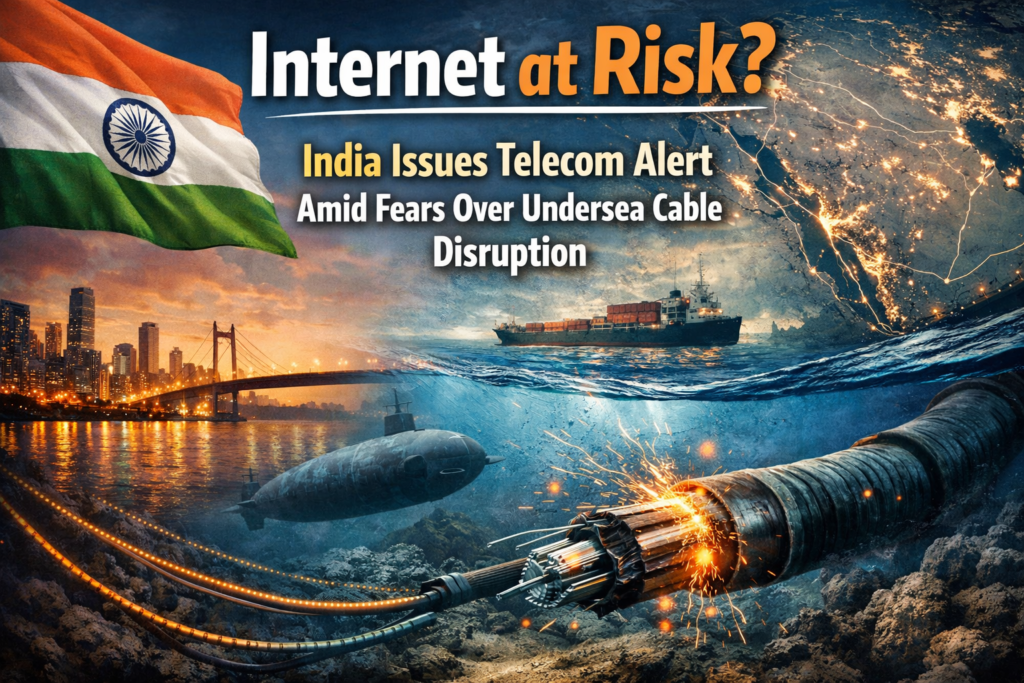
India telecom alert: The internet feels instant. A message is sent in seconds, a payment goes through, a video starts playing, and everything seems effortless. But behind that smooth experience, there is a hidden network doing the real work. A large part of global internet traffic travels through undersea cables, and if those lines are disturbed, the impact can spread across countries very quickly.
That is why India’s recent telecom alert has grabbed attention. Reports suggest the government has asked telecom companies and cable operators to review potential risks associated with submarine cable routes and prepare backup plans. The concern is tied to rising tensions in West Asia, where several important international cable paths pass through or near sensitive regions.
So the big question is simple: Can India’s internet really be affected? The short answer is yes—but not in the way social media panic often describes it.
Why This Issue Is Bigger Than It Looks
India telecom alert: Most people think about internet problems only when mobile data slows down or Wi-Fi stops working. But this situation is different. It is not about your router or SIM network. It is about the physical system that connects India to the rest of the digital world.
India today runs on internet-powered services more than ever before. Online banking, UPI payments, cloud storage, remote jobs, streaming, gaming, software services, and international business operations all depend on strong global connectivity. If those international links become unstable, the effect can be felt far beyond the telecom sector.
That is why this is not just a technical issue. It is also an economic and national infrastructure issue.
Read More: Official Government telecom authority pages
Read More: Big Update on LPG Cylinder Booking Rules 2026: New Changes That Could Affect Your Next Refill
What Are Undersea Cables?
Think of them as giant digital highways placed on the ocean floor. These fibre-optic cables carry massive amounts of data between countries and continents. Every time you open a foreign website, use an app with overseas servers, or join an international video call, your data may be travelling through one of these cables.
Many people imagine the internet as something wireless and floating around us. In reality, a large part of it is built on physical infrastructure. And physical systems can be damaged.
That is exactly why submarine cables matter.
Why India Has Become Alert Right Now
India telecom alert: The concern is linked to strategic sea routes near conflict-prone areas. Some of India’s international data traffic depends on cable systems that connect through routes around the Red Sea, Arabian Sea, and nearby corridors.
If any important cable route gets damaged or blocked, data can still be rerouted—but only to an extent. Alternate paths have limits. Once too much traffic gets pushed onto backup routes, performance begins to drop.
That means the internet may still work, but it may not work smoothly.
Will the Internet in India Completely Shut Down?
No, that is highly unlikely.
India is not connected to the world through just one cable. There are multiple cable systems, different landing stations, and backup arrangements already in place. Telecom companies build redundancy because cable faults are not rare events.
So if there is a disruption, the more likely outcome would be:
- slower international browsing
- higher latency
- delays in cloud-based services
- unstable video calls
- slower response from overseas servers
In other words, it would feel more like digital traffic congestion than a total blackout.
How Undersea Cables Usually Get Damaged
Many people think cable damage only happens during war or sabotage. While conflict can increase the risk, most cable faults are often caused by more ordinary problems.
Some common reasons include:
- ship anchors dragging across the seabed
- fishing activity in busy marine zones
- natural seabed movement
- equipment failure
- delayed maintenance and repair access
This is what makes submarine cables so interesting and so vulnerable at the same time. They power modern internet life, but they are still exposed to very old-world risks.
What Problems Could Users Notice?
If a major route is disrupted, average users in India may not instantly lose access to everything. Instead, they may begin to notice small but irritating changes.
1. Slow International Websites
Websites or platforms hosted outside India may open more slowly than usual.
2. Video Call Issues
Calls on global apps may lag, freeze, or lose audio quality.
3. Cloud Service Delays
Businesses and startups using international cloud systems may face slower dashboard access or backend delays.
4. Gaming and Streaming Impact
Online games connected to foreign servers may show higher ping, and some streaming services may buffer more often.
5. Business Workflow Disruptions
Companies that rely on overseas clients, servers, or software systems could face operational slowdowns.
So yes, people may notice it—but probably not in a dramatic “everything is dead” way.
Why This Matters for India’s Economy
This is where the issue becomes serious.
India is no longer just a country that consumes internet services. It is now a major digital economy with global software exports, IT services, cloud dependence, and international business connectivity. A slowdown in international data movement can directly affect productivity, service quality, and business performance.
That is especially important for:
- IT companies
- SaaS businesses
- financial platforms
- data centres
- outsourcing firms
- startups using global cloud tools
For such sectors, even a small delay in network performance can create a larger business problem.
What the Government Is Trying to Do
The reported telecom alert appears to be more about preparedness than fear. The idea is simple: identify weak points before something goes wrong.
That means telecom operators may be reviewing questions like:
- Which cable routes are most exposed?
- What happens if one major path is interrupted?
- How quickly can traffic be shifted elsewhere?
- Are fallback systems strong enough?
This is the kind of planning that often goes unnoticed when everything works well—but becomes extremely valuable during disruption.
Can India Reduce This Risk in the Future?
Yes, but not instantly.
Building internet resilience is a long-term infrastructure job. It requires investment, route diversification, better repair coordination, and stronger backup systems.
A smarter long-term approach may include:
- more diverse cable routes
- stronger landing station networks
- faster repair permissions
- Better coordination between telecom and maritime agencies
- more local hosting of data and services
These steps may not sound flashy, but they are exactly what make digital systems stronger over time.
What Should Normal Users Do?
For now, there is no reason to panic. But it is still wise to stay practical, especially if your work or studies depend heavily on stable internet access.
A few useful habits can help:
- Keep important files downloaded offline
- Save backup copies of work documents
- Have a secondary internet option if possible
- Avoid relying only on live cloud access for urgent work
These are small precautions, not emergency steps.
Conclusion
India’s internet is not about to disappear overnight, but the concern around undersea cable disruption is real. These cables are a hidden yet critical part of modern digital life, and any trouble along key international routes can create visible effects in speed, latency, and service reliability.
The recent telecom alert should not be seen as a warning of total collapse. It should be seen as a reminder that even the most advanced digital systems depend on physical infrastructure below the surface.
And that is the real takeaway: the internet may feel invisible, but it is far more fragile than most people think.
1. Why has India issued an India telecom alert?
India has reportedly issued a telecom alert to review possible risks linked to undersea internet cables. The goal is to make sure telecom companies and network operators are prepared if any important international cable route gets disrupted.
2. Can an undersea cable disruption affect the internet in India?
Yes, it can. If a major cable route is damaged, internet traffic may need to be shifted to backup routes. That can lead to slower browsing, higher latency, and delays in cloud-based services.
3. Will the internet completely shut down in India?
No, a complete internet shutdown is unlikely. India is connected through multiple submarine cable systems, so backup routes exist. However, users may still notice speed drops or unstable international connectivity if one or more major routes are affected.
4. What are undersea internet cables?
Undersea internet cables are fibre-optic cables placed on the ocean floor. They carry huge amounts of digital data between countries and continents, making global internet communication possible.
5. Why are undersea cables so important for India?
These cables support India’s international internet traffic, including websites, cloud services, business operations, video calls, streaming, and digital payments connected to global networks.



Pingback: MP Board Result 2026 Date Out? Class 10th & 12th Result Expected on 20 April -
Pingback: RBI New Rule 2026: OTP Alone Will Not Work for Online Payments After April 1 -