

India’s online payment habit has changed faster than most people expected. A few years ago, cash was still king in many homes. Now, groceries, recharge, bill payments, subscriptions, shopping, ticket booking, and even chai money often move through a phone screen. But the more digital India becomes, the smarter fraud also becomes. That is exactly why the RBI new rule 2026 is getting so much attention.
From April 1, 2026, a simple OTP is no longer enough for many online payments. The new payment security framework requires two-factor authentication (2FA) for digital transactions, adding another verification layer beyond just an OTP. Reports around the rollout say this applies across major digital payment methods, including UPI, cards, and wallets.
So if you are the kind of person who quickly types an OTP and finishes payment in five seconds, things are changing. Not in a scary way, but in a very real, everyday way.
This article explains what the rule means, why it matters, how it may affect your daily payments, and what you should do next.
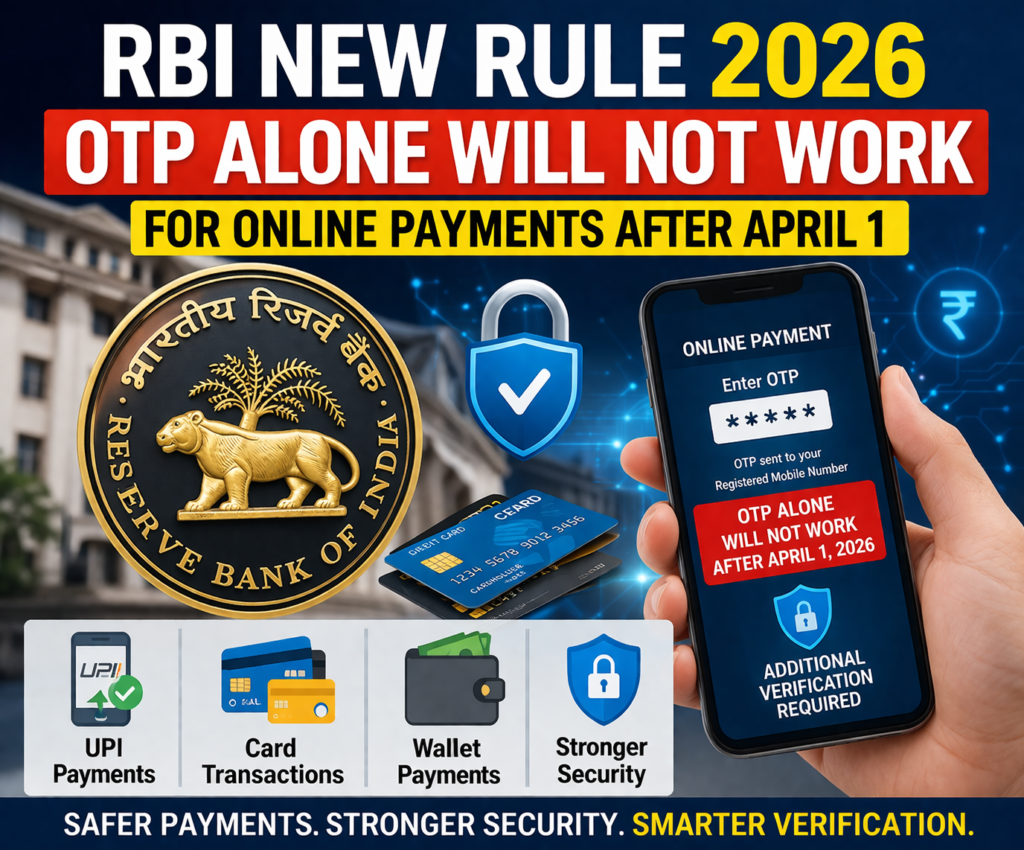
What Is the RBI New Rule 2026 All About?
The headline is simple: OTP by itself is no longer considered strong enough protection for digital payments.
That does not mean OTP is disappearing. It still matters. What changes is its role. Earlier, many users thought, “If I got an OTP, my payment is secure.” RBI’s updated direction moves beyond that thinking. Now, one-time passwords are treated as only one layer, not the entire lock on the door.
The new system is built around multi-step verification. In practical terms, your transaction may now require a combination such as:
- OTP + PIN
- Password + biometric
- Device verification + OTP
- UPI PIN + app-level confirmation
This shift is designed to reduce fraud, especially in cases where criminals manage to trick users into sharing OTPs. News coverage of the rollout describes the rule as a broad move to make online transactions harder to exploit through phishing, SIM-swap scams, and account takeovers.
Read More: RBI New Rule 2026 official website
Internet at Risk: India Issues Telecom Alert Amid Fears Over Undersea Cable Disruption
Why RBI No Longer Trusts OTP Alone
Here is the uncomfortable truth: OTP feels safer than it actually is.
Most people trust OTP because it arrives on their personal mobile number. That gives a false sense of control. But fraudsters no longer need to “hack” like movie villains. Many scams today are psychological, not technical. They manipulate people, not machines.
A scammer may:
- Pretend to be a bank support
- Send a fake KYC update link
- Ask you to “verify” a refund
- Trick you into screen sharing
- Use a cloned app or phishing page
In such cases, the OTP becomes useless if the user is fooled into giving it away.
That is why RBI’s new digital payment rule focuses on stronger identity checks. The idea is simple: even if one layer gets compromised, the second layer can still block the fraud.
And honestly, that makes sense. If one tiny 6-digit code can unlock your money, that system was always going to age badly.
What Exactly Changes After April 1, 2026?
For users, the biggest change is this: online payments may involve one more verification step than before.
That does not mean every single payment will suddenly feel complicated. In fact, many apps and banks may keep the process smooth in the background. But the system will be stricter behind the scenes.
You may notice changes like:
- More app-based confirmations
- Fingerprint or face unlock during payment
- Additional checks on a new device
- Extra verification for high-value transactions
- Smarter fraud screening before payment approval
Several reports also mention a risk-based authentication approach, where regular low-risk transactions may feel simpler, while unusual or high-risk ones trigger extra checks. That means if you suddenly log in from a new phone at midnight and try a large transaction, the system may stop pretending everything is normal.
And frankly, that is a good thing.
Will This Rule Affect UPI Payments Too?
Yes, UPI users are part of this shift, too.
A lot of people assume this rule is only for debit or credit card payments, but the digital payment ecosystem is wider now. UPI has become such a huge part of daily life that any serious payment security reform would naturally include it.
If you use apps like:
- Google Pay
- PhonePe
- Paytm
- BHIM
- bank UPI apps
…you may notice stronger verification flows depending on the transaction type and risk level.
Some reports indicate that users may need an additional step beyond only entering the UPI PIN, especially for certain transaction scenarios or app environments.
So no, UPI is not “ending.” It is just growing up.
How Card Payments May Feel Different Now
If you frequently shop online, card payments may be where you notice the change first.
Earlier, a common payment journey looked like this:
- Enter card details
- Receive OTP
- Submit
- Done
Now, banks and payment gateways are moving toward stronger authentication logic. Depending on the platform, your card payment may involve:
- device recognition
- token-based validation
- banking app confirmation
- biometric authentication
- password or PIN support
This may feel slightly slower at first. But it also means stolen card details alone are less useful to fraudsters.
That matters more than people realize. In many online fraud cases, the victim does not even know where their card data was leaked. By the time they notice, the money has already moved.
This RBI update is basically saying: one stolen layer should not equal instant access.
And that is the kind of rule that may annoy users for 10 seconds but save them thousands later.
What About Wallets and Saved Payment Methods?
Yes, even mobile wallets and stored payment setups may become stricter.
People love convenience. Saved cards, one-click payments, recurring billing, and wallet balance usage—these features make online spending almost frictionless. That convenience is great until the wrong person gets access.
Under a stronger authentication ecosystem, payment platforms are expected to improve how they verify:
- user identity
- device trust
- payment intent
- transaction risk
So if you have been living a “tap and forget” payment life, you may now see a few more security prompts.
That does not mean digital payments are becoming difficult. It means they are becoming less careless.
There is a difference.
Will Online Payments Become Slower?
Short answer: a little, sometimes.
But not enough to panic.
Yes, there may be a few extra seconds in some cases. Especially when:
- You switch phones
- Install a fresh app
- Use a new browser
- attempt a large payment
- pay on an unfamiliar website
However, for regular users on trusted devices, many payment systems are expected to stay fairly smooth through intelligent authentication design. The purpose is not to frustrate people. The purpose is to make fraud less easy than “OTP entered, transaction done.”
And if we are being honest, waiting 6 extra seconds is still better than spending 6 days chasing customer support after a scam.
Biggest Benefit: Better Fraud Protection for Common Users
This rule matters most for normal people, not tech experts.
Your father is paying the electricity bill.
Your sister is ordering books online.
A student recharging data.
A shopkeeper pays a vendor.
A freelancer subscribing to software.
These are exactly the people who often become targets because they are busy, trusting, or distracted.
The biggest advantage of the RBI’s new online payment rule 2026 is that it creates more room for suspicious transactions to be stopped before the money leaves.
That is huge.
Because once fraud succeeds, the emotional damage is often bigger than the financial loss. People start fearing digital payments. They stop trusting banks. They become nervous about every SMS and every call.
Security rules like this are not just about technology. They are about restoring confidence.
Will Banks Be More Responsible Now?
This is one of the most important parts of the conversation.
The new framework is not only about users being careful. It also increases pressure on banks and payment platforms to implement stronger systems and respond properly to fraud complaints.
Coverage around the rollout notes that institutions may face greater accountability if security safeguards are not properly followed, and complaint resolution is expected to become more serious under this stricter environment.
That is the right direction.
For too long, digital fraud conversations often ended with, “The user should have been careful.” But security should not depend entirely on whether a tired person taps the wrong link at 11:47 PM.
A healthy system protects people even when human judgment fails.
That is what modern banking should look like.

What Should Users Do Right Now?
You do not need to become a cybersecurity expert overnight. But you do need to become a little smarter.
Here are practical steps that actually matter:
1. Keep Your Banking and UPI Apps Updated
Old app versions are lazy invitations for trouble.
2. Turn On Biometric Lock
Fingerprint or Face ID adds real-world friction for fraudsters.
3. Never Share OTP, PIN, or Screen Access
Not with “bank staff,” not with “refund teams,” not with anyone.
4. Review Saved Devices
Remove old phones or unknown logins from banking apps.
5. Watch for Fake Payment Pages
Fraud links often look almost real. “Almost” is enough to steal money.
6. Use Trusted Apps and Merchants
Random websites with massive discounts are often expensive in a different way.
7. Check Transaction Alerts Immediately
The earlier you spot a problem, the better your chances.
These are not dramatic hacks. Just basic habits. But basic habits save real money.
How This Rule May Change India’s Payment Culture
This is not just a banking update. It is a behavior update.
The next phase of India’s payment story is not only about faster transactions. It is about trusted transactions.
That is a more mature digital economy.
It means users will slowly stop asking, “How quickly can I pay?” and start asking, “How safely can I pay?”
And that is a better question.
Because digital payments are no longer a side habit, they are now part of how the country functions.
Final Thoughts on RBI New Rule 2026
The phrase “OTP alone will not work” may sound dramatic, but the logic behind it is actually simple and overdue.
Scams have evolved. Payment habits have evolved. So security had to evolve, too.
The RBI new rule 2026 is not trying to make life difficult for users. It is trying to make fraud more difficult for criminals. That is a very different thing.
Yes, some payments may take an extra step. Yes, a few users will complain. Yes, there will be a short adjustment period. But if that small inconvenience helps prevent stolen money, fake approvals, and payment fraud, then the change is worth it.
In the end, this rule sends one clear message:
In 2026, digital convenience without digital protection is no longer acceptable.
FAQ’s
What is the RBI New Rule 2026 for online payments?
RBI New Rule 2026 is a digital payment security update under which OTP alone may not be enough for many online transactions after April 1, 2026. Users may need an extra verification step.
Will OTP stop working completely after April 1, 2026?
No, OTP will not stop working completely. It will still be used, but in many cases, it may not be enough on its own to complete a transaction.
Will this RBI rule affect UPI users?
Yes, UPI users may also see stronger verification for some payments, especially in high-risk or unusual transaction situations.
Will online payments become slower because of the new RBI rule?
Some transactions may take a few extra seconds due to additional verification, but the purpose is to improve payment safety and reduce fraud.
Why has the RBI introduced this new payment rule?
RBI introduced this rule to reduce online fraud, phishing scams, OTP theft, and unauthorized transactions in India’s growing digital payment ecosystem.
Will card payments also be affected by this update?
Yes, debit and credit card payments may require stronger authentication beyond OTP in some online transactions.