

If you are searching for a strong SRH vs LSG IPL 2026 article with ranking keywords, let’s keep it real first: this match is scheduled for April 5, 2026, in Hyderabad, so the actual “turned the match upside down” moments have not happened yet. The fixture is officially listed for the Rajiv Gandhi International Stadium, Hyderabad.
But that does not make this topic weak.
In fact, this is exactly the kind of article fans love before toss time—because some matches are decided long before the final over. A dropped catch, one reckless over, one captaincy gamble, one batter refusing to slow down… that is how SRH vs LSG can swing from one side to the other in a blink.
So instead of writing a fake match report, here is a sharper and more useful piece: the 7 moments most likely to turn SRH vs LSG IPL 2026 upside down.
And honestly? This game has chaos written all over it.

SRH vs LSG IPL 2026 Official IPL website
GT vs RR IPL 2026: Match Preview, Playing 11, Pitch Report & Winning Prediction
1) The First 12 Balls of Travis Head and Abhishek Sharma
This is where Hyderabad matches often become unfair.
SRH does not always wait for the game to settle. They like to start as if the scoreboard is already demanding 15 an over. That is exciting when it works. It is a disaster when it doesn’t. Against LSG, those first two overs will carry ridiculous value.
If Travis Head and Abhishek Sharma connect early, LSG’s bowlers could spend the next 18 overs trying to repair emotional damage. A pair of boundaries is one thing. But if SRH reach 30-plus before the third over ends, the field spreads, plans crack, and bowlers begin guessing instead of executing.
On the other hand, if LSG grabs one wicket inside those opening 12 balls, the entire texture of the innings changes. Suddenly, SRH is not dictating. They are reacting.
That is not a small shift. That is the match breathing differently.
2) Rishabh Pant’s First Counterattack Window
Some players bat according to the scoreboard. Rishabh Pant has never really believed in that system.
If LSG loses an early wicket, all eyes go straight to him. Not because he must rescue the innings in the old-school “anchor” way, but because Pant can reset momentum in ten deliveries. That is his danger. He can make a bowling side feel in control and then wreck that feeling before they finish adjusting the field.
Against SRH, Pant’s most important phase may not be the death overs. It could be the period between overs 7 to 11.
That is where innings often wobble. Singles dry up. Captains sniff pressure. Batters start manufacturing shots. If Pant survives that section and flips it with one aggressive burst, LSG can steal back command without needing a giant partnership.
There is a reason why some innings feel bigger than the number on the scorecard. Pant does that.
3) The Over Where Heinrich Klaasen Meets Spin
This could be the nastiest mini-battle of the afternoon.
There are certain moments in T20 cricket where everyone watching knows what is coming, but the bowler still has to stand there and deal with it anyway. Heinrich Klaasen vs spin is one of those moments. It does not look dramatic at first. Then one over disappears.
If LSG tries to control the middle overs through spin and Klaasen is already set, that plan can go from sensible to regrettable very fast. He does not just hit boundaries—he breaks rhythm. A captain can spend six overs building pressure, and Klaasen can erase that work in eight balls.
That is why this phase matters so much.
If LSG’s spinners survive Klaasen, they stay alive in the contest. If Klaasen wins that duel, SRH can run away with the innings before anyone properly notices the damage.
Sometimes the match does not turn with a wicket. Sometimes it turns with one batter refusing to let bowlers breathe.
4) Pat Cummins’ Captaincy Gamble in the Middle Overs
Now here is the less glamorous but highly dangerous part of this game: captaincy timing.
Pat Cummins is not the kind of captain who panics loudly. His decisions usually look calm from the outside. But in T20 cricket, one “calm” move can either look genius or completely backfire in six minutes.
The real pressure point will come when LSG is somewhere around 75/2 or 85/3. That is the stage where captains either attack for wickets or protect the boundary.
And both choices carry risk.
If Cummins keeps a slip-type attacking field too long, one over can vanish. If he becomes too defensive too early, LSG can quietly rebuild and finish strong. That balance is brutal in Hyderabad, where one set batter can punish even decent plans.
A lot of fans only remember sixes and wickets. But very often, the match turns because a captain waited one over too long to make the obvious change.
That one over hurts more than it should.
5) The Death Overs: Where Bowlers Either Survive or Get Exposed
Forget everything else for a second.
This match might simply come down to overs 17 to 20.
That is where IPL games stop being neat and start becoming emotional. Yorkers become full tosses. Slower balls sit up. Captains suddenly look ten years older. And if the batting side still has finishers left, the game can flip with brutal speed.
For SRH, this phase matters because their batting style naturally creates late-over violence. For LSG, it matters because they have hitters who can drag a chase back from nowhere. One side will probably feel “slightly ahead” at the 16-over mark. That feeling means absolutely nothing if the final overs go wrong.
A team can bowl well for 16 overs and still lose by 20 runs worth of panic.
That is why death overs are not just a phase. In SRH vs LSG IPL 2026, they may become the entire story.
6) One Unexpected Indian Player Could Hijack the Spotlight
Every big IPL match has that one player who enters with less noise and leaves with the game in his pocket.
Not the superstar. Not the headline machine. The other guy.
Maybe it is a lower-order hitter who smashes 28 off 10. Maybe it is a domestic seamer who nails slower balls when the big names miss. Maybe it is a young spinner who sneaks in a double-wicket over while everyone is focused elsewhere.
That is the beauty of this fixture.
Everyone will talk about Head, Pant, Klaasen, Cummins, and Pooran. Fair enough. But T20 cricket often turns because one so-called “supporting player” decides he does not feel like being a supporting player that day.
Those are the moments fans remember with the loudest laugh later:
“Bro, match toh ussi ne palat diya tha.”
And they are right.
7) The Toss Might Matter More Than People Want to Admit
People love pretending that toss discussions are lazy analysis. They are not—especially in a game like this.
At Hyderabad, the conditions, heat, surface behavior, and scoreboard pressure can combine in weird ways. Batting first can look ideal if the pitch stays true. Chasing can feel easier if the target is visible and dew or fatigue creeps in later. One decision at the toss can shape batting intent before the first ball is even bowled.
But here is the deeper part:
The toss only matters if the captain uses it well.
Winning the toss and then misreading the pitch is worse than losing the toss entirely. If either side chooses the wrong route—too aggressive with the bat, too defensive with the ball, too safe too early—the match can tilt before the crowd has even finished settling in.
That is why the toss in SRH vs LSG IPL 2026 is not just a ceremonial coin flip. It could be the first real turning point.
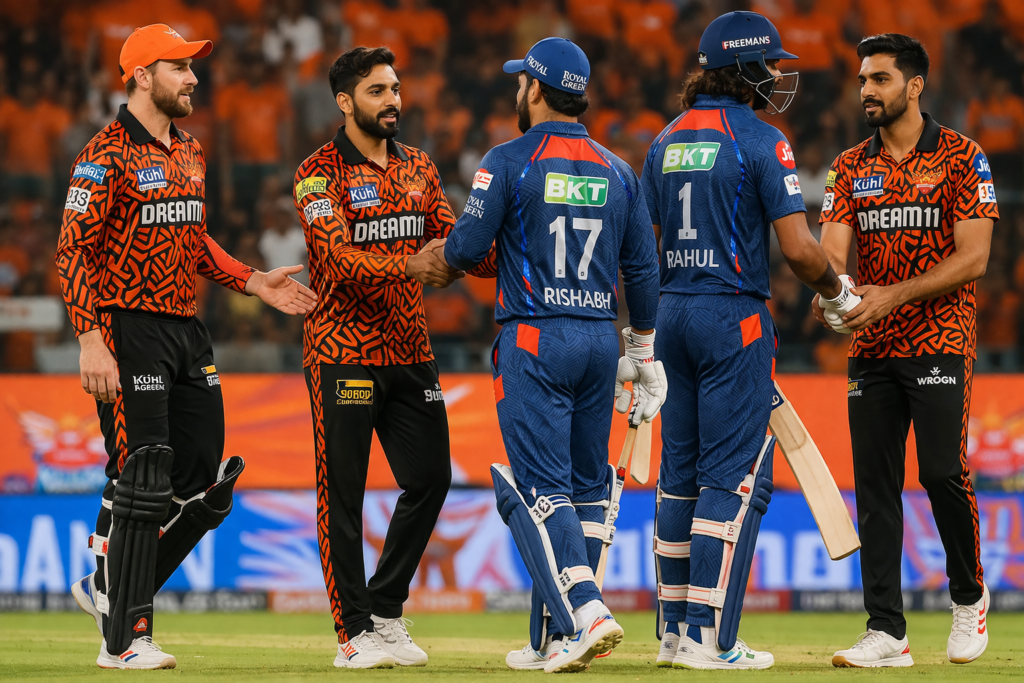
Who Holds the Edge Before the Match Starts?
If you judge purely by attacking instinct, SRH look slightly more dangerous. Their batting can turn a decent total into a ridiculous one. At home, that edge becomes even sharper.
But if the match gets dragged into tactical cricket—middle-over pressure, clever bowling changes, slower scoring pockets—LSG become very uncomfortable opponents. They are not the kind of team you bury easily if they stay within touching distance.
So the real answer is simple:
- If this becomes a boundary race, SRH are the favourites
- If it becomes a nerve test, LSG can absolutely flip it
And that is exactly why this contest feels so alive before it even begins.
Conclusion
SRH vs LSG IPL 2026: 7 Moments That Could Turn the Match Upside Down is not just a catchy headline—it is genuinely the best way to read this fixture. This is one of those IPL matches where the winner may not be decided by “the better team” in a broad sense. It may come down to a tiny stretch of cricket that lasts six minutes and changes everything.
The opening burst. Pant’s counterattack. Klaasen versus spin. Cummins’ tactical calls. Death-over execution. One surprise performer. And yes, even the toss.
That is your real preview.
Because when SRH and LSG lock horns, the match usually does not drift in one direction politely.
It jerks.
It swings.
It turns upside down.
FAQs
Q1. What were the biggest turning points in SRH vs LSG IPL 2026?
The biggest turning points in SRH vs LSG IPL 2026 were the powerplay attack, middle-over pressure, spin battle, death overs, and tactical captaincy calls.
Q2. Who played the most important role in SRH vs LSG IPL 2026?
The most important role in SRH vs LSG IPL 2026 usually came from the batter or bowler who changed momentum during the pressure overs.
Q3. Why was SRH vs LSG IPL 2026 such a close match?
This match stayed competitive because both teams kept finding ways to shift pressure back, especially during the middle and final overs.
Q4. Where was the SRH vs LSG IPL 2026 played?
SRH vs LSG IPL 2026 was scheduled to be played in Hyderabad at Rajiv Gandhi International Stadium.
Q5. Why is SRH vs LSG IPL 2026 trending online?
Fans are searching for SRH vs LSG IPL 2026 because of its exciting matchups, turning points, and high-intensity IPL moments.